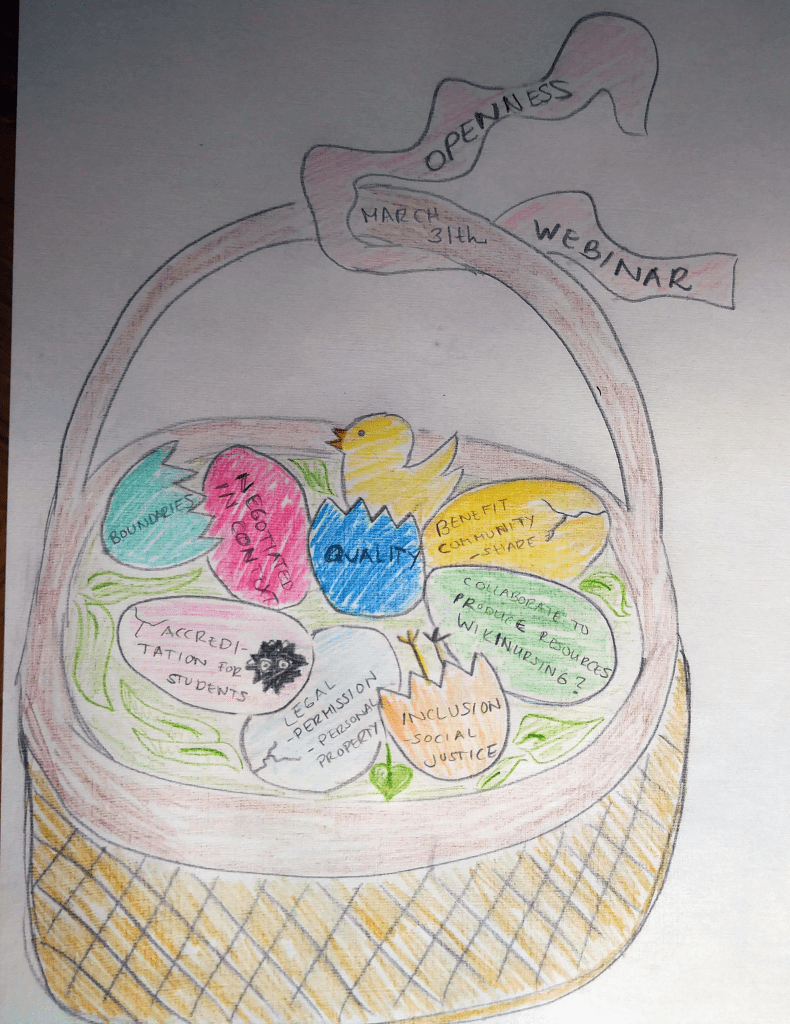
From the podcast, I began to think about openness in education and it´s an ongoing process now really. Openness and how I/we practice it in my work became our presentation to the PBL Community. The leaders of Topic 2 had organized the weeks to minimize stress. We also had time for in-depth discussions about our experiences of openness and some in the group had, for example, experience of MOOCs, but in most cases openness was limited and needed some registration. Thanks to Cormier (2010), I knew something about what a MOOC is. I actually never knew about it before.
From the Maha Bali lecture on March 23 and the article by Bali & Jhangjani (2020), I was inspired to create a model about content-centric or process-centric, teacher-centric or student-centric and pedagogical or social justice. Conclusion: I need to address more process-centric, student-centric and social justice in my work as a teacher.
During Topic 2, I thought a lot about the way forward. How should I use the knowledge I learn in my work? Are there others in the teaching team who will want to work with new ideas in our courses? Imagine if we could have these discussions, which we have had in the PBL group, within the teaching team. Collaboration is important. Some colleagues want to return to the way of working before Covid and others are curious to explore new ways. Maby we have to negotiate it in our context? In any case, I will be changed forever, even if things remain as before, I will be better able to understand different opportunities and choices to promote different kinds of openness.
I have also become more aware of which images I can legally use thanks to Process Arts' (2011) explanation of creative common. I myself have looked for pictures on free websites like unsplash.com, search creative commons.org, pixabay. com, moderskeppet.se, dmkommunikation.se, material.io, pexels.com. Unfortunately, there are not many specific care images. I sent an email to the nurses' handbook of medical technology for nurses and they described how I can do when I use their pictures but that it is only legal within my training assignment, that the material may not be edited and that they must be stated as a source. It solves only a very small part of my work though. A person at the university says that you "can" use other images as well if you keep your material only on mymoodle and do not publish in public. It is still difficult when you know that you are using an image illegally
Referenser:
Bali, M., Cronin, C., & Jhangiani, R. S. (2020). Framing Open Educational Practices from a Social Justice Perspective. Journal of Interactive Media in Education. 2020 (1), p. 10.
Cormier, D. (2010). What is a MOOC? (Video). https://www.youtube.com/watch?v=eW3gMGqcZQc
Hahn, J. et.al. Perspectives of openess. (Audio). https://blog.nus.edu.sg/openeducation/audio-podcast/
Process Arts. (2011). Creative commons licences explained (Video). https://www.youtube.com/watch?v=4ZvJGV6YF6Y
 Anna-The Teaching Nurse
Hello Anna! What a nice drawing! Happy Easter! It’s nice to hear that you’ve started thinking about how you can apply what you’ve learned in ONL in your future teaching. You raise a very good point on the importance of having a discussion in the teachers’ community at your institutions. Any ideas for realizing that? We have a closed FB group at our institution, but it’s mostly used to share practical, usually technology-related issues (e.g. How can you do it on Zoom that…?) and not so much as a forum for elaborated, deep, discussions like in ONL PBL groups. What are your ideas on developing supportive, dialogic teaching communities?
I share the struggle with finding legal images. I’ve used the websites that you mention in your post. At our institution, we were told that we could use images (other than free stock photos) only if we cite the source fully and not share the result of our work outside the LMS (so the situation is a bit similar to yours). Judit
GillaGilla
Thank you for sharing your thoughts with me, Judit. I believe that ONL has made openness conscious for me so I can choose or not choose it for different parts of my work. Some things I can change and other things can change over time in collaboration with others. It’s a bit like a seed is planted but we still do not know which flower will be the result. I wish you a happy Easter too.
GillaGilla
Some tips on sources for OER in healthcare are found in a guide by University of Maryland (USA) https://sph.umd.edu/content/open-educational-resources-oer-public-health. The Health Education Assets Library (HEAL) is a collection of over 22,000 freely available digital materials for health sciences education (see https://library.med.utah.edu/heal/). MERLOT has a vast repository of health science resources from many universities https://bit.ly/3rR2SQz.
GillaGilla
Thank you!
GillaGilla
Hi Anna! Nice to read your reflections. I also teach nursing, and share your experience in sometimes struggeling to find relevant pictures and other material. (Thank you @alacre for the tips).
I also can relate to what your write about teams and collaboration, and that different people have different views of how to proceed post-corona. Some are thrilled about new ideas, others want to go back to the pre-covid situation as soon as possible. I don’t know if you speak swedish, but if you do, the Facebook-group- ”Digital omställning i högre utbildning NU” is a great source of inspiration.
GillaGilla
I speak swedish and have now joined the group. Different networks are everywhere, sometimes it’s just about how to find them. You found me one. Thank you!
GillaGilla