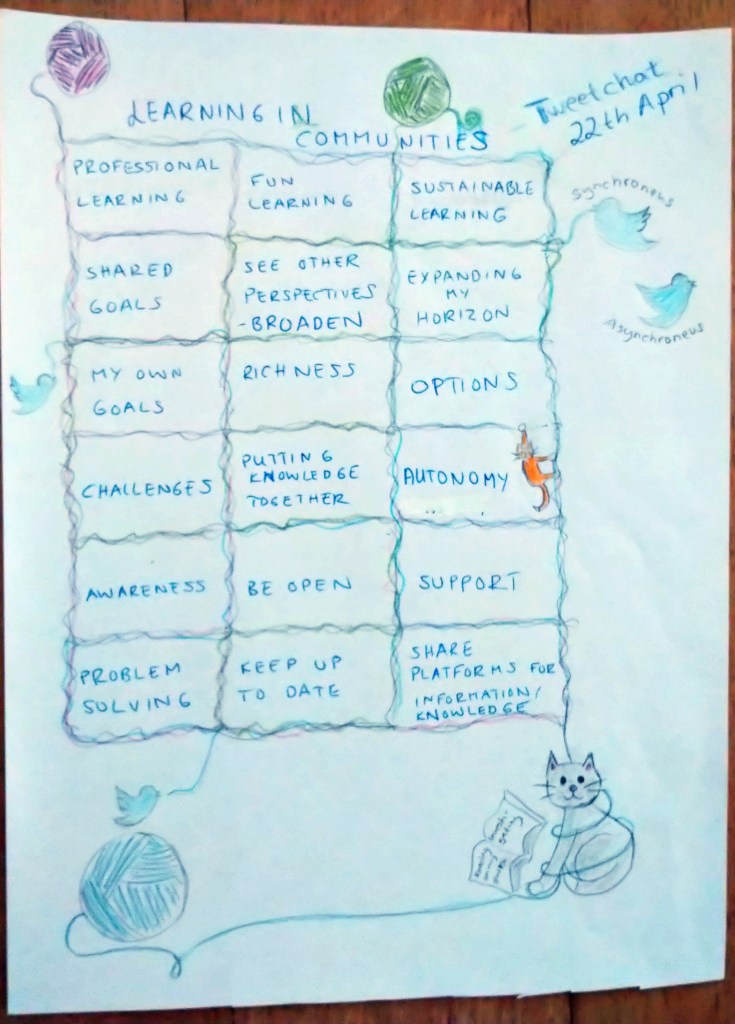
New week, new topic started well with Kay Oddone's lecture on April 13. After that, I thought that I have many communities that I work with and share goals with. Most of my activities in communities are synchronous, face to face. The seminar also pointed out the importance of asynchronous activities to give people the ability to process and think. That's an important question for me, because I need time to reflect on myself. The week, we had synchroneous, as well as asynchroneus activities in PBL11. Communication in society is intentional, people know each other, have shared goals and strong relationships and mutual responsibility (Oddone, 2019a).
I have a very small network for personal learning, PLN. Almost all my informal learning with open social networks that I create myself came with this ONL course such as blog, twitter, teacher facebook group. I am on this course to get professional development as a teacher. Oddone (2019b) describes the PLN as undefined, not planned, flexible, changeable and driven by individual learning goals. I was happy with my learning before I started, then this course changed me when I realized new alternatives for me if I actively widen my PLN.
Kay Oddones (2019) found that teachers in open network learning could experience unclear boundaries and certain disadvantages but the benefits such as self-esteem, support, solidarity and the ability to access a broader perspective were also found. I see both these pros and cons. It's exciting to explore with the others in the group but it's easy to spend a lot of time when I get involved. Capdeferro & Romero (2012) mentions that online collaboration can be frustrating related to asymmetric collaboration, different commitments, and quality of contributions. However Brindley, Walti & Blaschke, (2009) found that small collaborative groups with support and clear instructions can lead to better learning goals. They presented implications for practice that I found very interesting.
I think that our facilitators in PBL 11 really provide good guidance for developing our knowledge in collaboration and it has really been a very good experience to see their work as well as how our learning has evolved in PBL11. The work in my “community” PBL 11 is getting better and better and this time the leaders tried Miro for collaborative learning. I can really see the benefits and the work was so well organized this week. Thank you Carl and Nadia, our topic leaders. I find it easier and easier to use technical tools now also.
Brindley, J., Blasche, L., Walti, C. (2009). Creating effective collaborative learning groups in an online environment. The International Review of Research in Open and Distance Learning, 10 (3)
Capdeferro, N., Romero, M. (2012). Are online learners frustrated with collaborative learning experiences? The international review of research in open and distance learning, 13 (2), 26-44.
Oddone, K. (2019a). PLN Theory and practice, part 1 (Video) https://www.youtube.com/watch?v=g8mJX5n3IEg
Oddone, K. (2019b). PLN Theory and practice, part 2 (Video). https://www.youtube.com/watch?v=LqSBTr9DPH8
Oddone, K. (2019). Teachers´experience of professional learning through personal learning networks. (Thesis) https://eprints.qut.edu.au/127928/
 Anna-The Teaching Nurse
Our communities are built on trust and are familiar whereas our networks can consist of many looser connections to people we have never met or interacted with but whom we trust. The challenge is building and maintaining both our communities and networks and benefitting from them. One example for me is LinkedIn where I have lots of connections I have never had any contact with but who seem to be in my field and could be useful some day. I have different criteria for each network about who I want t connect with – some more restrictive than others.
GillaGillad av 1 person
Thank you for sharing this. Network can be rewarding as well as challenging, I think. Good to have different criteria. I have not developed criteria yet, because I have not thought about that yet. I have some contact with the authors of a web-based nursing handbook. I teach a lot of the procedures that are described in their web-based book and sometimes I don´t agree with their material or some material that I find important, is missing. They are always open for a discussion, but I never seen anyone of them in real life. That´s a network I really trust and they always respond to my questions referring to evidence. They update the material all the time so it´s really great.
GillaGillad av 1 person
Thank you for your post. An important thing is that you realize how much your group and yourself have changed during the ONL course. I think that that evolution is part of the process. I am also motivated by the enormous work that our facilitators are doing to helps us to work together. Most of the time, I feel that I am learning more from the group members than from the topics. A crucial part of the PNL and collaborative learning.
GillaGillad av 2 personer
Thank you for commenting on my blog. I agree with you.
GillaGillad av 1 person
Interesting post, Anna. While I have also been reflecting on my PLN, I have been thinking a lot about how to widen my student’s PLN’s and how to facilitate collaborative learning practically in my classroom to avoid frustration related to, as you say, ”asymmetric collaboration, different commitments, and quality of contributions”. Here I have thining about designing tasks that are less about the outcome and more about the process. Ironically, this has been a learning journey in and of itself.
GillaGillad av 2 personer
Well done, Anna. I like your habit of creating small paintings that show how you got inspired and also your take-aways from the topic in question. In particular, I like what you write on extending ones PLN – that is something that I also found very inspiring, new and probably fruitful. I wish you a great summer. All the best/ Carl
GillaGillad av 1 person
Thank you Carl!
GillaGillad av 1 person